Android Expansion and Flutter Rewrite: From Mobile Success to Cross-Platform Evolution
Android Expansion and Flutter Rewrite: From Mobile Success to Cross-Platform Evolution

Once I achieved stable revenue on iOS, I started dreaming: "If I could earn the same amount on Android, my revenue would double!" However, that path was far from smooth.
Android Development: Challenges and Struggles
November 20, 2019 - I began my Android development journey.
Language and UI Barriers
Since this was my first time with Android development, I faced many challenges. The most difficult part was the difference in UI creation approaches. Coming from iOS Auto Layout, Android's layout system felt like something completely different, and I spent frustrating days unable to create screens as I envisioned.
My development device was also old, which caused issues with proper functionality on newer Android devices. Despite being full of bugs, I somehow managed to release on January 5, 2020.
Revenue Performance (iOS + Android)
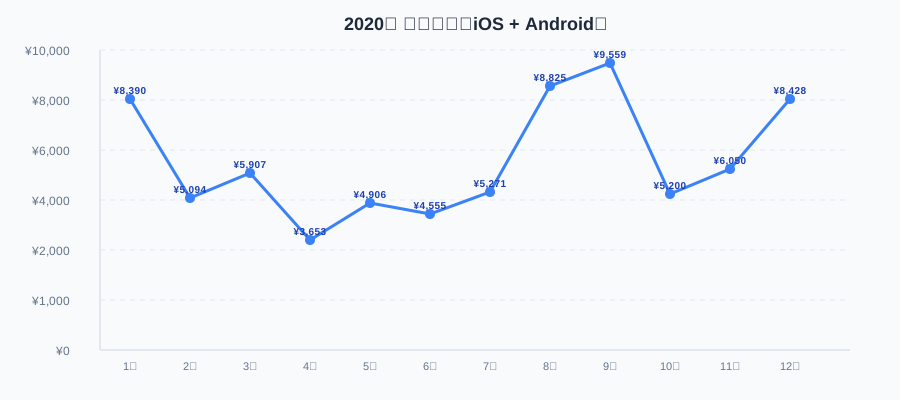
Here's the revenue trend after releasing the Android version:
| Month | Combined Revenue |
|---|---|
| 2020/01 | ¥8,390 |
| 2020/02 | ¥5,094 |
| 2020/03 | ¥5,907 |
| 2020/04 | ¥3,653 |
| 2020/05 | ¥4,906 |
| 2020/06 | ¥4,555 |
| 2020/07 | ¥5,271 |
| 2020/08 | ¥8,825 |
| 2020/09 | ¥9,559 |
| 2020/10 | ¥5,200 |
| 2020/11 | ¥6,050 |
| 2020/12 | ¥8,428 |
Combined revenue stabilized at several thousand to ten thousand yen per month. In reality, most of this revenue came from the iOS version, with Android's individual revenue being very limited. My initial expectation of "doubling the revenue" didn't materialize.
However, this was the case for my app. Results vary greatly by app, and many developers have achieved significant success with Android.
The Flutter Option
The Appeal of Cross-Platform
Around that time, I learned about Flutter - a framework that allows simultaneous development for both iOS and Android. The ability to support both platforms with one codebase was extremely appealing from a development efficiency perspective.
Learning Through 6 Books
To learn Flutter, I purchased and devoured the following 6 books:
- Mobile Collection: MVVM, SwiftUI, and Flutter App Development
- Flutter Mobile App Development Bible
- Practical Flutter Development for the Real World
- Learn by Building: App Development with Flutter and Firebase
- Introduction to Android/iOS Cross-Platform Framework Flutter
- Learn Flutter from the Basics
I started rewriting with Flutter on May 31, 2021. Despite the different language, this being my second time around allowed me to proceed with development quite smoothly.
Flutter Release
Since I was rebuilding anyway, I decided to thoroughly identify and address all the issues pointed out in user reviews:
Key Issues Addressed:
- Slow performance → Performance optimization
- Confusing UI → Complete design overhaul
- Limited features → Added ranking system
- Hard to find settings → Reorganized settings screen and improved navigation
Additionally, I implemented the most requested feature: online multiplayer. This allowed friends to play together remotely, significantly enhancing the app's enjoyment.
On July 13, 2021, the Flutter version incorporating all these improvements was released.
Unexpected Success and Anxiety
Explosive Revenue Growth
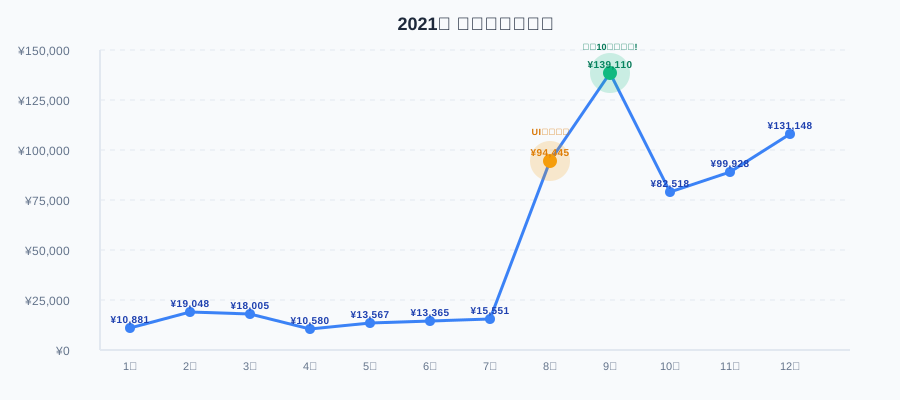
Revenue grew rapidly in 2021 after the Flutter release:
| Month | Revenue |
|---|---|
| 2021/01 | ¥10,881 |
| 2021/02 | ¥19,048 |
| 2021/03 | ¥18,005 |
| 2021/04 | ¥10,580 |
| 2021/05 | ¥13,567 |
| 2021/06 | ¥13,365 |
| 2021/07 | ¥15,551 |
| 2021/08 | ¥94,445 |
| 2021/09 | ¥139,110 |
| 2021/10 | ¥82,518 |
| 2021/11 | ¥99,928 |
| 2021/12 | ¥131,148 |
The revenue surge in August 2021 was shocking. I was able to earn ¥3,000 per day, and I still remember my wife's surprise. Then in September 2021, monthly revenue finally exceeded six figures at ¥100,000 for the first time.
The Truth Behind the Success
The revenue surge wasn't solely due to migrating to Flutter. Rather, I believe it was the result of various improvements accumulated during the rebuild:
- Systematically resolved user review issues
- Significantly optimized performance
- Complete UI design overhaul
- Added online multiplayer functionality
- Introduced competitive elements through ranking system
These improvements led to 17,200 downloads in August 2021, with MAU (Monthly Active Users) reaching 20,000.
I expected "this would keep climbing to hundreds of thousands of yen," but reality wasn't so sweet. New features brought new bugs, and the churn rate remained high. Afterward, revenue stabilized in the ¥80,000 range, but compared to the peak months earlier, I felt tormented by anxiety.
Lessons from Revenue Fluctuations
Understanding the Waves
Once humans experience high revenue, it becomes the new normal. Then when revenue decreases, we feel anxious even at levels that should have been perfectly fine before.
This is an emotion that anyone earning ad revenue from app development likely experiences. If you understand from the beginning that revenue naturally has waves, you won't feel unnecessarily anxious.
Japan's Smartphone Market
Research at the time showed that about 70% of Japanese users were iPhone users, which helped me understand why Android revenue didn't match iOS's - it was a market size issue. Market dynamics differ between Japan and overseas, so it's important to constantly research the latest market trends.
From Side Hustle to Filing Taxes
In 2021, I finally became a sole proprietor and filed my first tax return. I truly felt that I had taken a big step, growing to the point where I was paying taxes from my side hustle.
- Tax filing requirement: Annual income of ¥200,000 or more
- Filing method: Chose blue return (special tax deduction)
- Expenses: Development devices, cables, books, etc.
Lessons and Takeaways
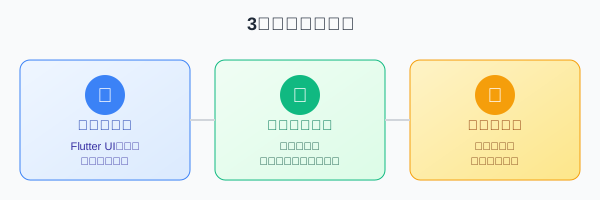
Technical Choices
- Android UI development is more challenging than expected for beginners
- Flutter offers intuitive UI creation with relatively low learning costs
- Previous native development experience helped with various Flutter release configurations
However, I'm not recommending Flutter to everyone. I see it as one option when you need to release on both Android and iOS. In my case, it worked well for development efficiency and UI creation, but native development has its own advantages.
Also, if targeting the Japanese market, starting with iOS only is a perfectly valid strategy. In Japan, where iPhone users are prevalent, you can potentially generate sufficient revenue with just an iOS version.
Business Strategy
- Validate on one platform first, then decide whether to expand
- Understand market characteristics: iOS dominance in Japan, varies by market overseas
- Cross-platform development offers efficiency benefits, but isn't mandatory
- Continuously analyze revenue changes (both increases and decreases) and improve
Mental Aspects
- Mental preparation for revenue waves is crucial
- Continuously improving little by little is the key to persistence
- When anxious, objectively analyze data instead of emotional reactions
Next Steps
Being able to achieve these results in 2-3 years of app development might have been partly due to luck. There were many times I felt like giving up, but seeing small daily revenue and knowing that someone out there was enjoying my app naturally kept me developing.
I hope this article helps those considering starting app development as a side hustle. I want to share real experiences from both the struggles and successes.