
5 Time Management Strategies for Side Business Success [A Father's Real Experience]

Starting a side business makes time management challenging. Balancing your main job with your side business while maintaining personal time requires effective time management strategies.
My Failure: Working Until Midnight Affected My Main Job
When I first started my side business, I felt rushed to "maximize every minute." This led to working until late at night, day after day.
The next day at my main job, I was too sleepy to concentrate, and I made more mistakes. My family time was sacrificed, and my wife became concerned. That's when I realized, "I can't continue like this."
What I learned was that "maintaining a sustainable pace" is far more important than "maximizing every minute."
Here are five time management strategies I learned from this failure.
1. Build Habits
By making your side business time a habit, time management becomes natural. Working on your side business at the same time every day creates a routine and makes work more efficient.
In my case, I've set weekday evenings from 9:00 PM to 11:00 PM as my side business time. After my children go to bed at 8:00 PM, I relax for about an hour before starting work.
On weekends, I prioritize family plans, but sometimes I work for 1-2 hours after coming home.
Adopt Identity-Based Habits
I recently read "Atomic Habits" and learned about Identity-Based Habits.
This approach focuses on forming habits based on "who you want to become" rather than "what results you want to achieve."
For example:
- ❌ "I want to live a healthy life" (result)
- ✅ "I want to be a healthy person" (identity)
Applying this to side business:
- ❌ "I want to succeed in my side business" (result)
- ✅ "I want to be a successful side business owner" (identity)
Aim for identity-based habits, not motivation-based ones.
2. Use Time Blocking
Divide your daily schedule into time blocks and assign specific tasks to each time slot. This increases concentration and reduces wasted time.
In my case, I work efficiently by doing different tasks on weekday evenings versus weekends:
- Weekday evenings (9:00-11:00 PM): Tasks requiring concentration, like development
- Weekend afternoons (1-2 hours): More relaxed tasks like article writing and marketing
This method fits my lifestyle, but finding the right time for yourself is crucial.
Morning people should use morning hours, night owls should use evening hours—match time blocking to your natural rhythm.
3. Prioritize Tasks
Consider task importance and urgency, then prioritize accordingly. Tackling important tasks first helps you use time efficiently.
Aim for Fastest Release: MVP Strategy
In app development, I prioritize completing an MVP (Minimum Viable Product) first to achieve the fastest possible release.
I postpone detailed feature additions and design improvements, prioritizing getting the product to market first.
I have two reasons for this:
- Early release allows me to get user feedback and identify improvement areas
- I want to quickly know "whether this app has potential"
Honestly, with limited time for side business, I want to avoid spending time on apps without potential. If user reaction shows no potential, I can pivot early to the next idea.
For my main app:
- December 16, 2022: Started initial work
- December 22, 2022: First release
Releasing the MVP in about one week was possible thanks to this prioritization.
By cutting many features and focusing only on essential functionality, I developed without strain. Now, it's an app generating tens of thousands of dollars in monthly revenue.
What matters isn't how much time you spent, but how efficiently you used that time.
4. Schedule Breaks
Working long hours reduces concentration. Taking appropriate breaks helps you refresh and work more efficiently.
Also, overworking can lead to burnout, making it difficult to continue your side business.
Using the Pomodoro Technique
I use the Pomodoro Technique: working intensely for 25 minutes, then taking a 5-minute break. Repeating this helps maintain concentration.
I also incorporate light stretching or walks between longer work sessions to refresh my body.
In my case, playing with my children serves as break time.
(Actually, when I'm working in my study, my children come in, so breaks become mandatory...)
5. Maintain a Sustainable Pace
This is the most important point. The biggest lesson from my failure story is that "maintaining a sustainable pace for the long term is more important than pushing hard for short-term results."
Don't Push Unless Urgent
I've set a rule: "Unless it's urgent, work after the children sleep." On weekends, I spend afternoons with my family.
By maintaining this pace, I continue my side business without sacrificing family time or affecting my main job.
Maintaining Motivation Before Revenue Appears
Honestly, there were tough times when I wasn't making money at first.
However, since the first release took only one week, it was easier to maintain motivation during development. Early release meant getting user feedback, which fueled my next motivation.
Real Schedule: A Father of Two's Daily Routine
For reference, here's my actual weekday schedule:
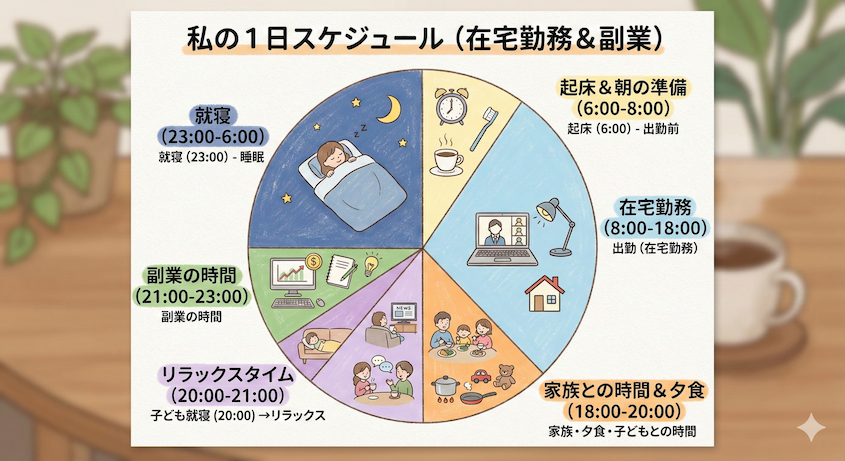
On weekends, I prioritize family plans, but sometimes work for 1-2 hours after coming home. Sometimes I work again at night after the children sleep.
Adapting Time Management as Children Grow
It's important to adjust time management methods as your children grow.
- When children were young: Worked during nap times
- Currently: Shifted to evenings and weekends
As children's routines change, so does your available time. Flexibility is key to long-term success.
Summary
Here are five time management strategies for side business success:
- Build habits - Focus on identity-based habits
- Use time blocking - Match it to your natural rhythm
- Prioritize tasks - Aim for fastest release with MVP
- Schedule breaks - Maintain concentration with Pomodoro Technique
- Maintain a sustainable pace - Don't sacrifice family time
By implementing these strategies, you can manage time efficiently and balance your side business, main job, and personal life.
Most importantly, "don't push hard for short-term results; maintain a sustainable pace for the long term."
I reached my current style through repeated failures. I hope you find time management methods that work for you and enjoy continuing your side business.